🎉 E47 - What's this about Whimsy!?! {020326}
Laugh all you want...🤪

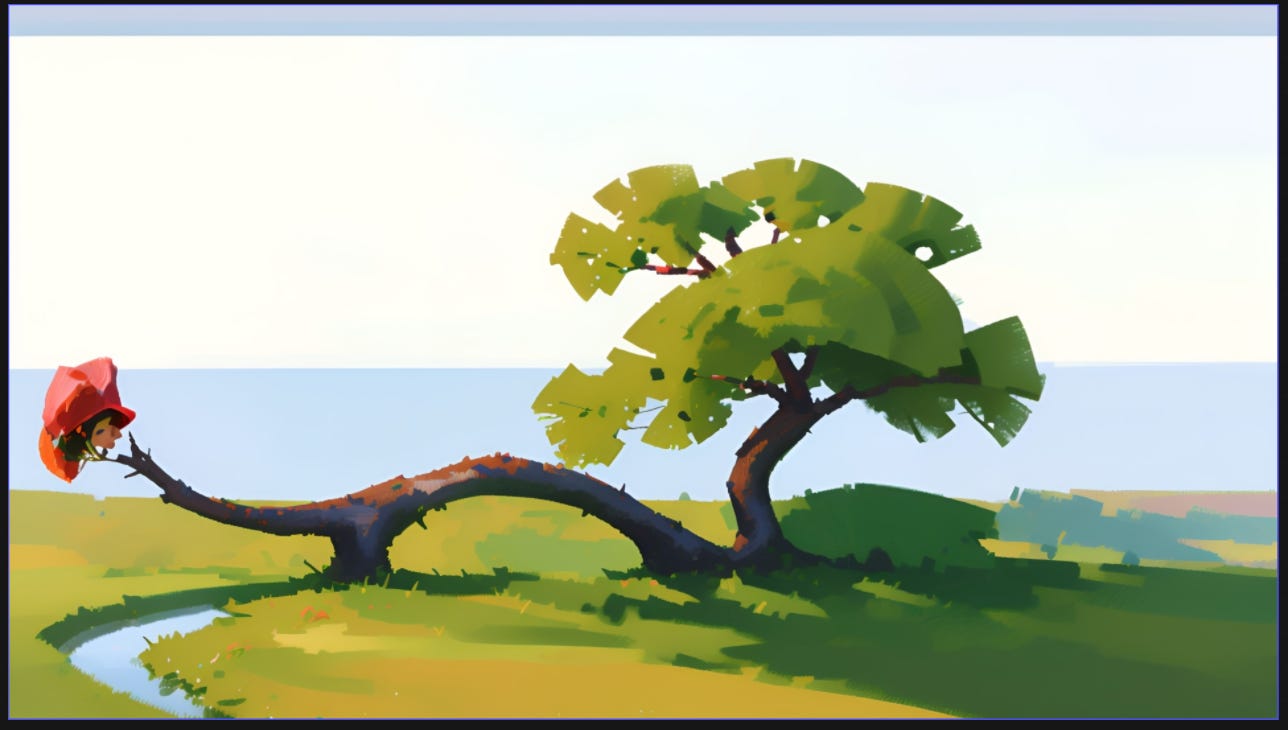
Think of a painting like a story.
Most of the time, the story is typical, right? Like, a picture of a tree is just a picture of a tree. It's nice, but it's a story we've all heard before.
Now, imagine if you painted that tree, but then you added something silly or surprising that doesn't belong. Maybe you put a giant, goofy-looking worm wearing a tiny hat on one of the branches. Or perhaps the tree trunk is made of colorful, striped candy.
That little, surprising thing is what we call whimsy. This post is an excerpt from a more comprehensive Guide to Whimsy in Visual Arts that you can download below.
Why is it valuable?
· It makes the picture more interesting and fun. Instead of just looking at the tree, your eyes go on a treasure hunt to find the unexpected thing. It makes you smile or even laugh.
· It shows your personality. When you add something silly, it's like you're putting a little piece of your own imagination and humor into the art. It's what makes your art unique and different from everyone else's.
· It's like a secret. The silly part isn't what the whole picture is about, but it's a special detail that only the person who really looks at the painting will notice. It's like you're sharing a little secret joke with the person looking at your art.
So, adding whimsy is like adding a fun little surprise to your art.

Section 1: The Philosophy of Whimsy
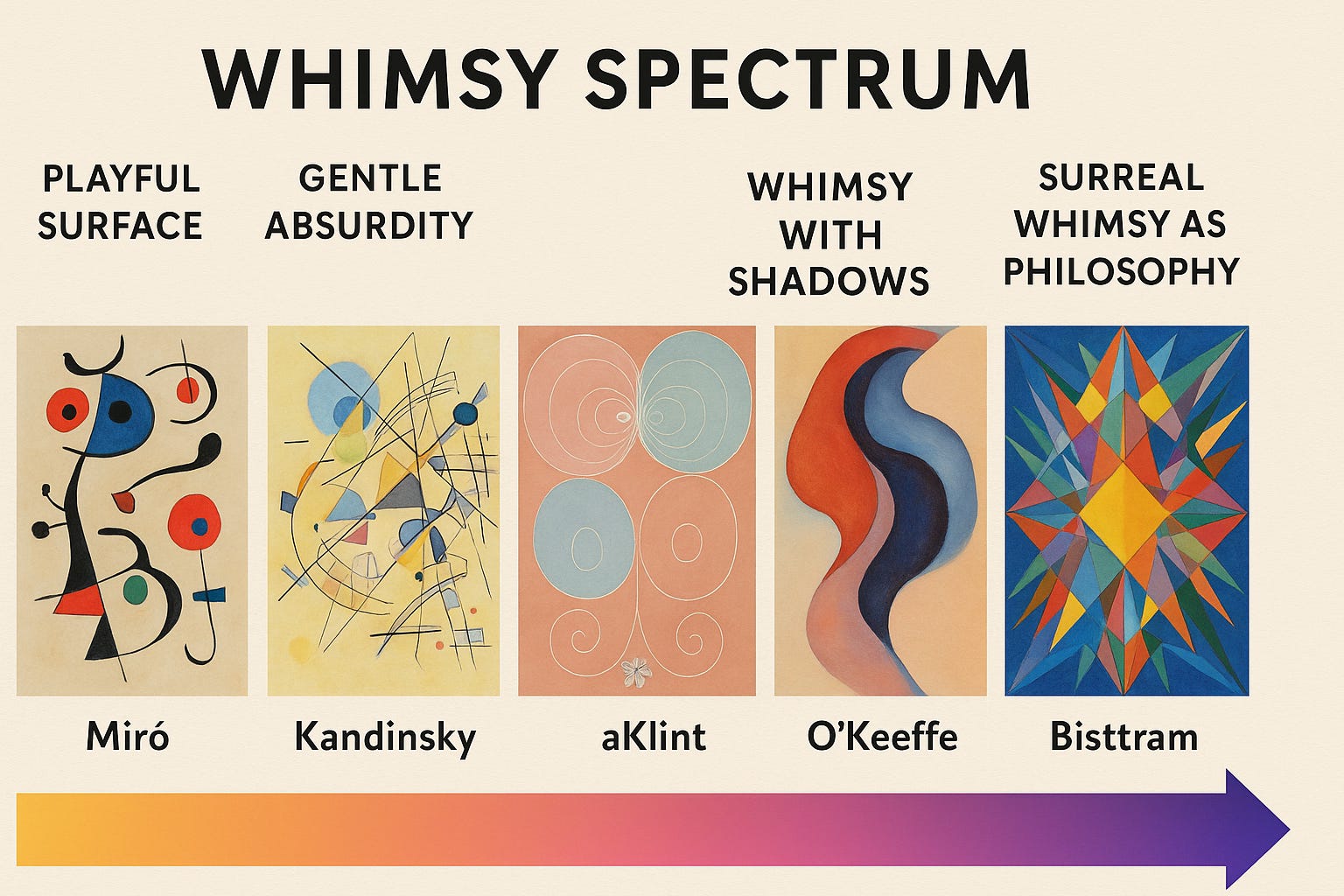
When an image feels playful, your mind tends to relax. That relaxation allows deeper, sometimes stranger, emotions to slip through. Example: Miró’s floating forms seem harmless, but linger long enough, and they start feeling oddly alive, even uncanny.
Whimsy allows joy and unease to coexist without one overpowering the other. The “cute but mysterious” balance can make an art piece stick in your mind far longer than pure beauty or pure darkness. Not the saccharine child-as-innocence cliché, but the raw imaginative mind we had before social conditioning told us which thoughts were “sensible.” This is why whimsical abstraction often feels familiar and alien at the same time.
Playful ambiguity gives you space to see your own narratives in the work. Whimsical art rarely dictates meaning—it leaves it open for you to supply, which engages your unconscious more actively.
Cultivate & Develop Ideas: Reframing Cleverness
You are not trying to be a stand-up comedian on canvas. You are training your artistic eye and hand to find and express the small, absurd, and delightful moments in abstract form. The artists you admire weren't born clever—they became clever through a lifetime of playful and observant practice.
Whimsy Spectrum
The Whimsy Spectrum is a way to consider how others have incorporated whimsy into their art. Whimsy can be a cute add, but it can also be a portal to a new world.
Think of it like this:
Dark, heavy art often hits you like a hammer—it declares its gravity upfront.
Whimsy is more like a secret tunnel: you enter and then find yourself in a much larger, stranger chamber than you expected.
How to Use the Spectrum
Ask: Where does this artwork sit on the spectrum?
Notice: Is its whimsy primarily visual (color, shape), conceptual (illogical scenario), or emotional (unexpected tenderness)?
Consider: Does the whimsy stay light, or does it deepen into something stranger, more emotional, or more philosophical over time?
Section 2: The Set-up
Here, we dig into intentions. It's less about drawing a funny face and more about creating a feeling of lightness and delightful surprise within your compositions.
Let’s use the metaphor of traveling somewhere. You can head out and see where the wind takes you, or you can have even a slight plan in place. For a plan, we need a Destination and then Choices to travel. As with most things art-related, there are no wrong answers, only your choices.
“Whimsy is more like a secret tunnel: you enter and then find yourself in a much larger, stranger chamber than you expected.”
North Star, Destination, and Travel Choices
I think of this intention as our North Star. These can be one or more but will guide you in how you approach whimsy in your work. For example:
1. I want to create art that evokes a silent giggle, a smile in the mind.
2. The work should stand even without the surprise; but be enhanced by it.
3. A charming surprise you discover when you look closely.
You don’t need many. I’ve listed more than one for example purposes. Maybe you want to consider other ideas to convey the destination that is the message. Check out the whimsy spectrum for more ideas.
There are as many ideas as you can think of!
By combining “Destination” with a “Travel Choice”, you are no longer leaving whimsy to chance. You're giving yourself a concrete roadmap to follow, and the more you practice, the more it will become a natural part of your artistic language.
C. Get the Show on the Road
This is about creating a sense of the target destination through your use of design elements.
Your first thought is not "what whimsical thing should I draw?" but rather, "how can I use shape, line, and color to create a playful narrative?"
The important thing is to move from thinking to doing. Tip: There are no wrong combinations.
The goal here is to consciously decide on a specific type of whimsy before you even pick up your brush or carving tool.
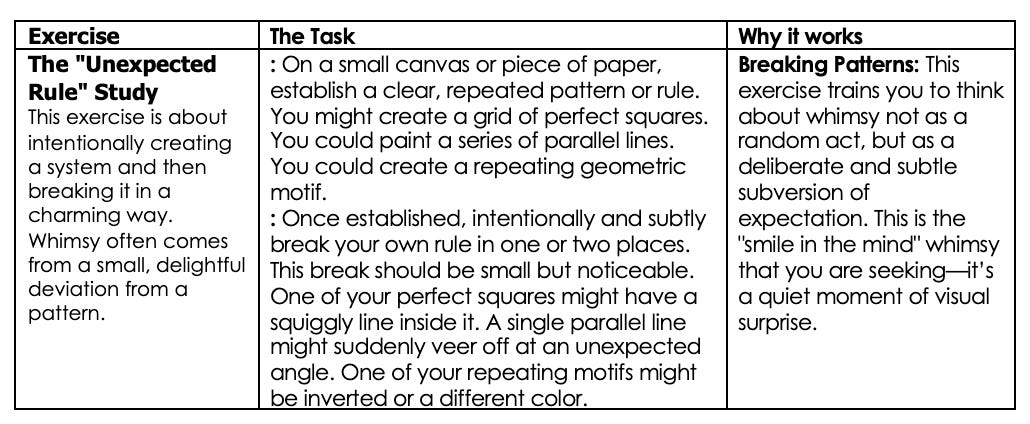
Section 3: Practical Exercises
Next, let’s put the ideas into practice.
Strengthen Connections
The comprehensive guide includes exercises and other tools to help you make informed choices. The goal of the exercises is to help you consciously build whimsy into your work from the very beginning, rather than adding it as an afterthought.