
E55: Accidental Elegance: Setting Rules to Unleash your Art {052626}
The Colors of We the People: a Visual DNA

I’m on sabbatical, but I had this experience that I wanted to pop in and share.
TL;DR
The Experiment: A rule-based test mapping colors and textures
The Goal: Bypass creative ego, safe habits, and traditional composition traps
The Discovery: Strip away the nouns and verbs of government accidentally to isolate meaning
Little-known fun fact: I have a specific and unusual form of synesthesia. If you’re not aware of this term, it just means I process signals (letters, sounds, numbers, tastes, etc.) in non-typical, cross-wired ways. So, I decided to try an experiment with some traditional crossed-wire forms; you know, just playing.
Experiment: mapping colors to non-visual data (aka. words) in ways that bypass standard composition traps, rules, and ego. It can provide an alternate way of seeing.
The rules I gave myself:
Take a short, complex piece of prose.
Assign specific colors to parts of speech (e.g., nouns = earth tones, verbs = high-chroma complements) and punctuation to physical textures,
Paint a panel strictly following this code without modifying it to look “nice”.
Note: this is not my usual crossed wires, so it was very intriguing.
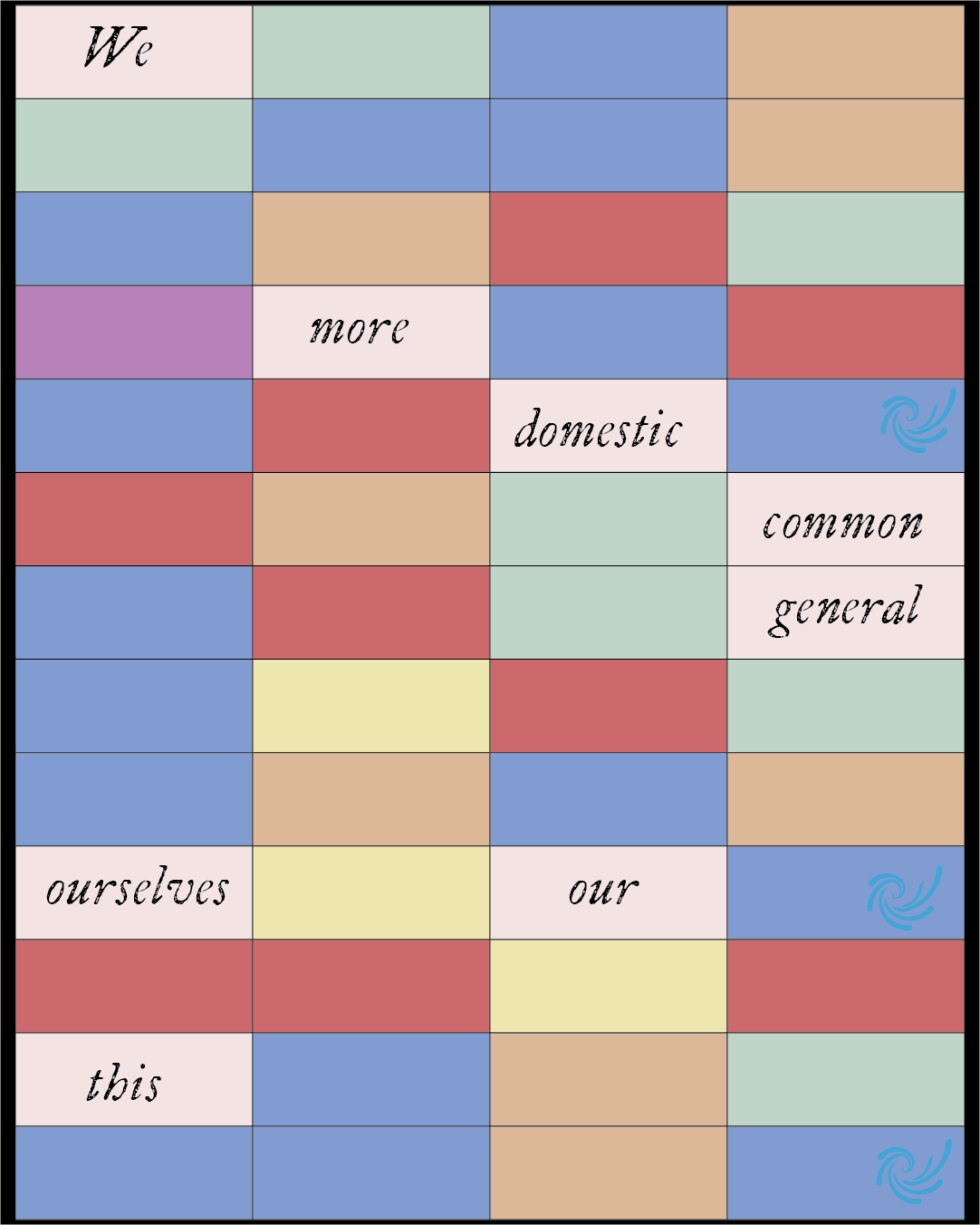
Using simple find-and-replace, I colored the nouns, verbs, adverbs, prepositions, articles, and conjunctions in the preamble to the U.S. Constitution.
Tbh, I was exploring for rhythms, emotion, structure; really anything interesting. What I found and learned:
Color notes: The pattern of tiles created a tapestry showing how the parts of speech kind of dance along with their color coding, which is evident.
Isolating the Core: The swapping left behind only a few adjectives and pronouns: We, perfect, domestic, common, general, ourselves, our, this. Once the nouns and verbs, etc., of government were neutralized, the focus instantly shifted to the emotional and philosophical identity of (WE) the people.
Accidental Elegance: The remaining words mathematically isolated the exact DNA of E pluribus unum (”Out of many, one”)—bridging individual, daily domestic lives into a singular, collective responsibility. 🌟
This finding was truly accidental. And it reinforced for me that, with art, you can start with a plan, then let what you learn guide you to a reasonable and possibly interesting result. Now, we’re not always about “a result”, but following a process, and investigation nearly always leaves some breadcrumbs that inform our work later.
🌟 “…it can help you see the familiar in a whole new way.” 🌟
When your mind fluidly switches perspectives, your brain is engaging in two distinct, rare cognitive phenomena. It imposes creative resistance and bypasses safe habits.
Potential Next Steps
You don’t have to have any kind of synesthesia to have fun with this sort of activity. At minimum, it can help you see the familiar in a whole new way.
Try this on a favorite chunk of text, song lyrics, or other materials, to see if the remaining words yield a similar philosophical distillation. Or perhaps the noun-verb-rhythms are particularly interesting.
The Modern Filter: Try this with modern manifestos, political speeches, or corporate mission statements. Is there a rhythm, or a genuine core, once the scaffolding is removed?
For more about changing perspectives in art, the US Constitution, et al:
Sources:
1. U.S. National Archives - The Constitution of the United States: Transcript
“Threshold Concepts and Troublesome Knowledge”
by Jan H. F. Meyer and Ray Land; Most-cited version: “Threshold concepts and troublesome knowledge (2): Epistemological considerations and a conceptual framework for teaching and learning.” DOI: 10.1007/s10734-004-6779-5; Reference page: University of Edinburgh entry
“The Psychological Construction of Confusion and Its Relationship to Complex Inferential Reasoning Performance”
by Sidney D’Mello et al. / DOI: 10.1016/j.learninstruc.2013.03.005; Publisher page: Learning and Instruction article
“The Science Behind Why Real Learning Sticks: How ‘Aha Moments’ Double Your Memory”
From Farnam Street, I could not verify an exact article with that title. It may be paraphrased or retitled in notes. The closest strong public-source match on the neuroscience of “aha” insight + memory is the Smithsonian / Quanta article on Aha Moments and memory, without a DOI, since it is a magazine feature article. (Smithsonian Magazine)
Cheers
Robin (take care of yourselves, friends)
This is really cool! Love the rules you gave yourself and how beautiful it turned out!